
Core Rules: Vendetta Patch Notes
Welcome to the patch notes for Riftbound: Vendetta. Included in today’s update are the new rules required to play with the mechanics included in the Vendetta set, as well as fixes to many logical and procedural errors.
Our first goal for this rules update is primarily to support the new cards in Vendetta when it releases to the English & Chinese audiences simultaneously! Compared to the Unleashed rules update, we’re focusing more of our energy on the new rules and systems for Vendetta than updates and changes to the overall mechanics of the game. We still have numerous bug fixes and areas of the rules that have been clarified and improved, but it is a smaller focus than it was in the Unleashed rules update.
Our second goal is to share the reasoning behind the changes we’ve made, so that you can understand why these changes are necessary and what cards or functions they support. Not all of the rules that have been changed are included in this document, but the changes and updates that were significant and merited deeper explanation to the community are ones we’ve elected to explain here. Additionally, all of the changes described in the Unleashed FAQ have been reproduced in the Core Rules Document and have been included here for completeness.
We’re releasing this rules update slightly early compared to our previous cadence. We heard player feedback from the updates which came with Unleashed and are adjusting our timing accordingly. This gives judges and players plenty of time to read any relevant rules before our first Pre-Rift events. The Vendetta rules update will be effective on July 24, 2026.
With that said, let’s take a look at the rules changes we have in store for Vendetta!
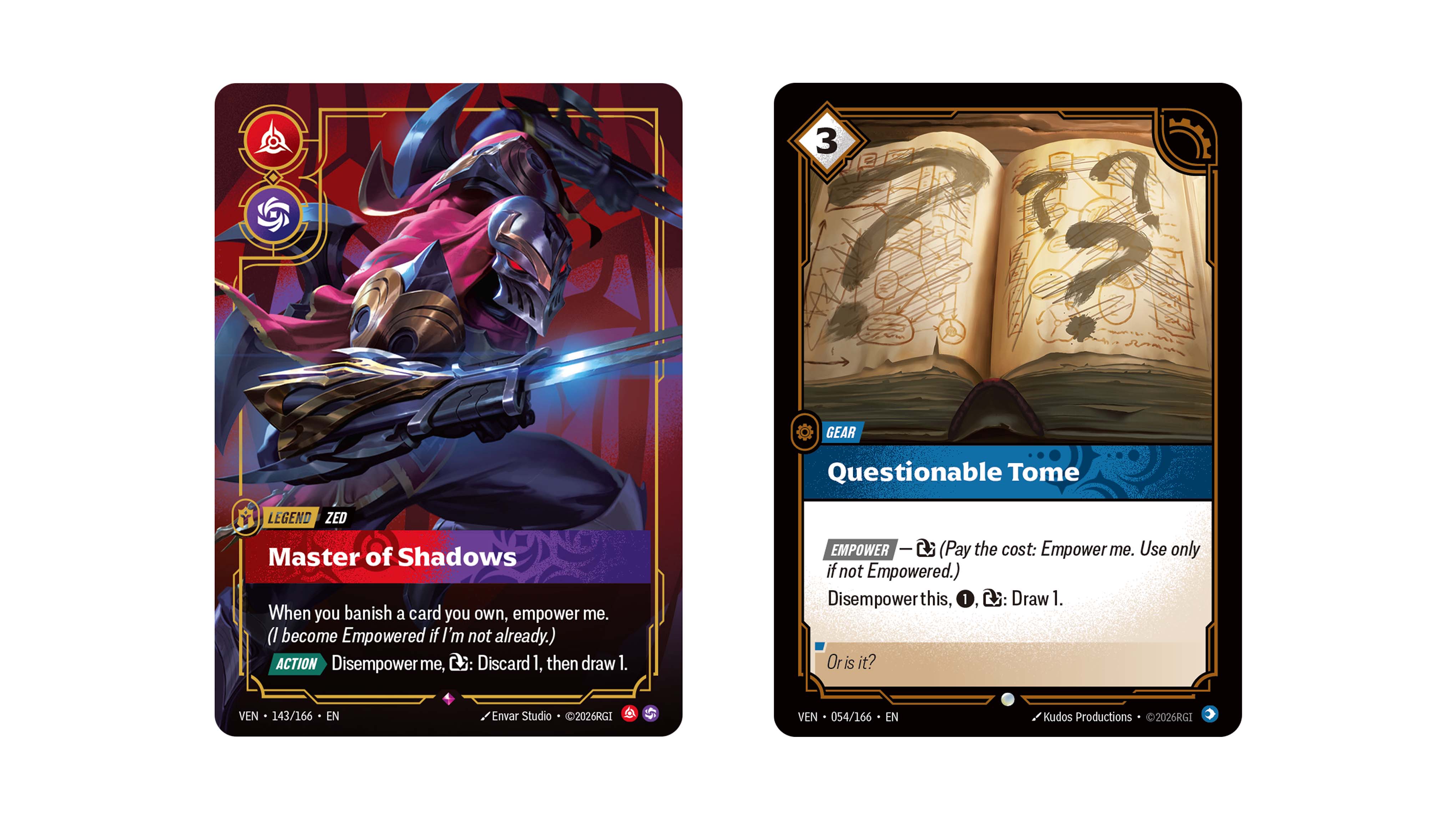
Vendetta Addition: Empower, Empowered, Disempower
- Empower is the tentpole mechanic of Vendetta. Units, gear, and legends can be empowered or disempowered.
- Empowered is a status that lasts indefinitely until the card leaves the board or is disempowered. The empowered status does nothing on its own, but can be referenced by other effects.
- Many cards in the set have the Empower keyword. This is an activated ability with an associated cost. You pay the cost, and your unit will become empowered! You can only activate this ability if the unit isn’t already empowered.
- If a card has an Empower ability, it likely also has an Empowered ability: this is a dependent keyword whose condition is the card having the empowered state. While the card is empowered, you get the extra effect!
- Some effects may also instruct a player to disempower a card as an instruction or a cost. Disempowering a card is the same thing as removing the empowered status from it. You can’t disempower something that isn’t empowered.
- NEW RULE: Empower keyword added.
- NEW RULE: Empowered keyword added.
- NEW RULE: Empower action added.
- NEW RULE: Disempower action added.
- NEW RULE: Empowered state added.
Vendetta Addition: Flow
- The second key mechanic from Vendetta builds on the concept of using abilities quickly in succession by allowing players to play spells from their trash. That mechanic is the Flow keyword!
- Flow is a keyword that appears on spells. It is a permission and an alternate cost. By playing a spell for its Flow cost, you can play it from the trash, then banish it. One and done.
- Cards with Flow also have a nifty symbol on their text box to indicate that they have a function from your trash! This symbol will be appearing on more cards in the future when we want players to know they should pay attention to a card in the trash.
- NEW RULE: Flow keyword added.
Vendetta Addition: Burn
- Speaking of trash shenanigans, one of the other major mechanics in Vendetta allows us to take cards directly from our Main Deck and put them in the trash! That is the Burn keyword.
- To burn X, a player takes X cards from the top of their Main Deck and puts them in their trash. Cards can trigger when burned, or when you burn a card, and effects can count the number of cards burned in a turn.
- Burning cards can bring you closer to burning out, but it can also add valuable flow cards to your trash.
- NEW RULE: Burn action added.
- Danger and value go hand in hand.
Vendetta Addition: Skip
- For the first time, a card has been printed that allows a player to skip part of their turn. In order to support that functionality, we’ve added a new action: skip. Skip is a replacement effect that replaces the named event or procedure of the turn with nothing. Anything that would occur as a result of that event or procedure of the turn doesn’t happen instead.
- NEW RULE: Skip action added.
- Poof! It’s gone. No triggers, no procedures, nada. Zip! Zilch!!
Vendetta Support: Naming Cards, Types, and Tags
- In Vendetta, we’ve added a card that instructs a player to name a card, in addition to the List from Unleashed that instructs a player to name a tag. With a preponderance of these effects, it’s time to define their function and the process by which a player names a card, type, or tag. Naming a card in particular is more complex than either type or tag, and has some special rules to give players some flexibility with how they name cards.
- NEW RULE: Naming cards, types, and tags added.
Vendetta Support: Ignoring Effects
- A new class of effect has been added in Vendetta: the ability to ignore certain abilities or effects. Fortunately, the machinery of inactive text allows us to cleanly manage how these effects operate, and they should be fairly intuitive to players.
- NEW RULE: Ignoring effects added.
Vendetta Support: Untargetability
- In Unleashed we had one new card that could make a card unable to be chosen by enemy spells and abilities based on a condition. In Vendetta, we are getting several new such effects and it is important for us to clarify how this set of abilities functions. We say that a unit with this property is untargetable.
- If a unit becomes untargetable after a spell or ability has already targeted that unit, the spell or ability will mistarget on resolution: any instructions related to that unit will be ignored. This is the same principle as a unit at a battlefield being targeted by Void Seeker and being moved to base in reaction to the spell. When Void Seeker resolves, any instructions related to that unit will be ignored because it is no longer at a battlefield as required by Void Seeker. Similarly, any instructions related to the untargetable unit will be ignored, because it too isn’t a legal target.
- NEW RULE: Untargetability added.
Vendetta Support: Making New Choices
- We have our second card that allows a player to make new choices for a spell on the chain. To support Mystic Reversal and this new spell, we’ve added rules for making new choices that will clarify the timing, legality, and nature of the choices allowed to be remade.
- NEW RULE: Making new choices added.
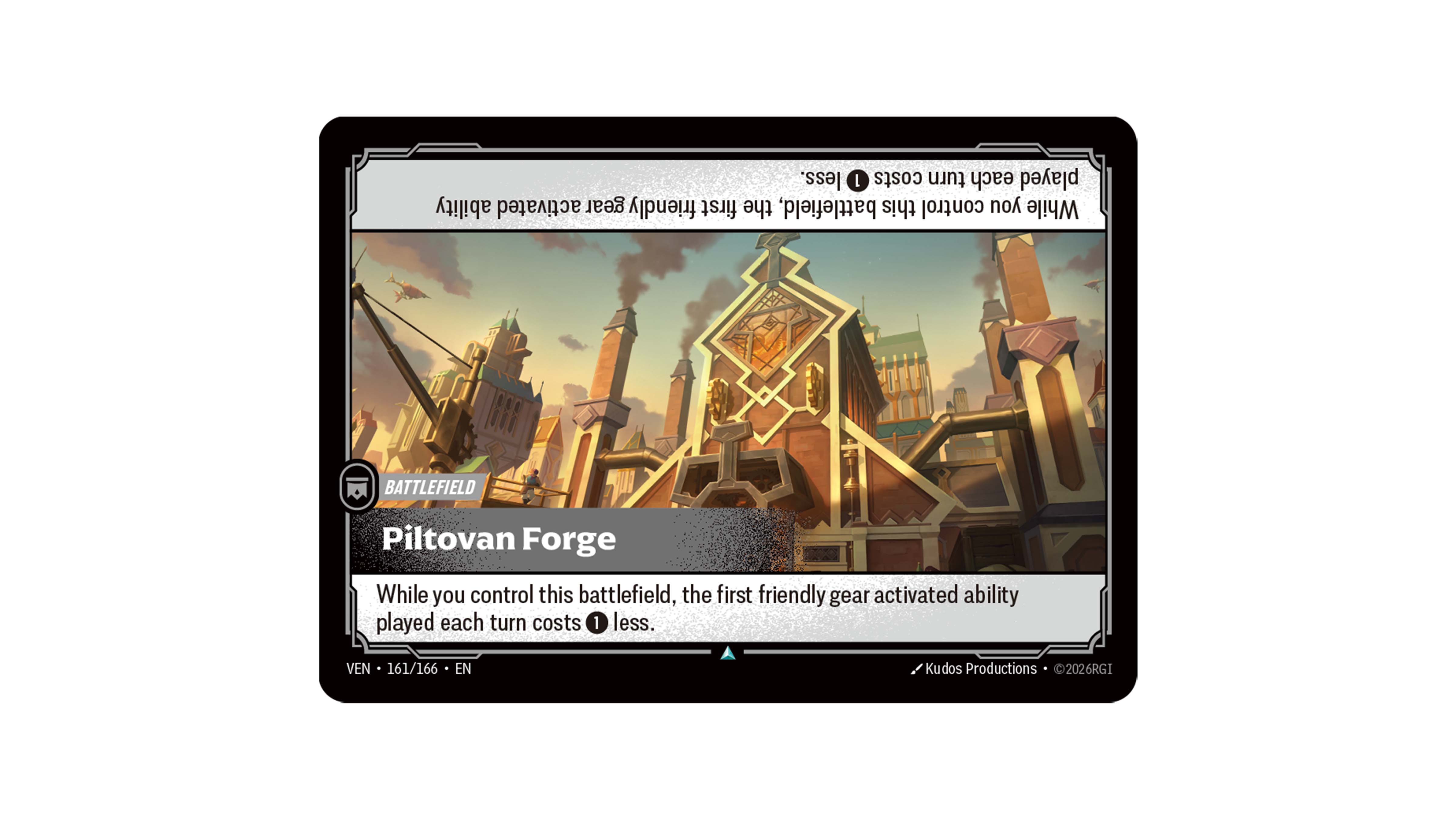
Vendetta Support: Activated Ability Terminology
- As of Vendetta, we’re shifting towards a new terminology for activated abilities in card text. On cards in previous sets, we’ve used the term “used” to refer to activating an activated ability which has led to some confusion over how it functions differently than playing a card. With Vendetta, we’re moving to the word “play” to refer to the act of activating an ability in card text. The Core Rules Document has been updated to refer to both uses of the term when discussing activated abilities.
- NEW RULE: “Use” and “play” supported for activated ability card text.
Vendetta Support: Cards with Multiple Types
- With the release of Vendetta, Riftbound has its first card with multiple card types. We’ve added rules that clarify how cards with multiple types function.
- NEW RULE: Cards with multiple types added
Vendetta Support: Replacement Effects and Combat Damage
- ‘Prevent’ being clarified in the Unleashed rules update has set the stage for more and more instances of it appearing on cards. As ‘prevent’ is becoming more prevalent, we’ve taken another look at how replacement effects interact with combat damage assignment. It was strange that ‘prevent’ as a replacement effect could modify how combat damage is assigned, while any other replacement effect that interacts with damage only applied at the moment that damage was dealt. Given how strict our combat damage assignment rules have to be, this led to very strange situations.
- We’ve done the technical work to ensure we can align how all replacement effects that interact with damage function during combat damage assignment. Now any replacement effect that would modify damage dealt to units during combat damage is applied to combat damage assignment instead. We’ve also updated the rules for how combat damage is assigned to remove inconsistencies this would cause.
- We will note that this means combat damage assignment when a unit has a replacement effect that increases damage like Lotus Trap will become slightly more complicated, as players must incorporate those replacement effects into their assignment calculations. We think that slight added complexity will be worth the increased intuitiveness of these effects having the same timing.
- NEW RULE: When assigning damage during the combat damage step, replacement effects that would apply to the resulting damage are considered to apply to the assignment instead.
Rules Update: Copying Tokens
- Token is no longer a supertype. It being a supertype made several cards work in problematic ways, and it wasn’t entirely intuitive that it should be a supertype. Now, regardless of how a token is manipulated, copied, or altered, it will maintain its tokenness. Cards, similarly, cannot become tokens for any reason.
- NEW RULE: “Token” is an intrinsic category of Game Objects, in the same way “card” is.
- NEW RULE: Token Game Objects cannot lose their token nature by any means.
- NEW RULE: Card Game Objects cannot become tokens by any means.
Rules Update: (Resource) Payment Optional
- The combination of Diana, Lunari and the change to how triggered abilities are processed led to players noticing a discrepancy in how resource costs are handled: if an Energy or Power cost is instructed to be paid and a player has that resource in their rune pool, they do not have the choice to avoid paying it. However, if they do not have that resource in their rune pool, there is nothing that can compel them to generate it—if they don’t generate it, the related action is ignored. We have long believed that the latter is an important protection for players, but the former leaves a strange discrepancy between these two cases. For players, the difference between being compelled to spend a resource and generate one is relatively small, and so it feels unintuitive and confusing that a player with unspent or “floating” Energy or Power will have a different set of choices than a player without. As such, we’re moving to make the payment of Energy and Power optional in all cases, to unify these two scenarios.
- This change will only affect cards like Diana, Lunari, Promising Future, and Cursed Sarcophagus that either instruct a player to pay Energy or Power, or instruct them to play a card without ignoring all of its costs. Regardless of whether or not a player has Energy or Power floating, they can choose either not to generate those resources or not to spend them.
- This only applies to Energy and Power. Any other cost can be compelled to be performed as long as the instructed player has the ability to do so.
- NEW RULE: When a player is instructed to Pay a resource, that player may remove that resource from their Rune Pool if it exists there. If they choose not to, the instruction is ignored.
Rules Update: Costs on Multi-Domain Cards
- We’ve aligned that it was strange that signature cards’ power costs could be paid with power of any domain. The power cost symbols have the colors of their domains, and players felt intuitively that you should pay for their cost with only power of those domains. In order to align better with player intuition, the power cost rules have been updated for cards of multiple domains.
- This means you’ll have to pay for a signature card’s power cost with a power of that card’s domains. If there is an [A] symbol in the card’s text, that can still be paid with power of any domain.
- CLARIFIED RULE: A [C] shorthand on a card with multiple Domains is processed as any power of that card’s Domains.
Rules Update: Applied Costs
- There is a class of abilities that apply a cost to an action outside of playing a card that we’ve seen in cards like Mageseeker Investigator. Those abilities were previously underdefined. Players understood intuitively how they should work, but we wanted to be clearer on the precise timing and function of these abilities. Additionally, we can give them a name! The costs applied by these abilities are applied costs.
- NEW RULE: Applied costs added.
Rules Update: Deathknell and “When I Die” Alignment
- The deathknell rules received a change in the Spiritforged rules update to allow them to use information from when its source was on the board. That was a much needed change, but it left other abilities that similarly triggered “When I die” to lag behind. In this rules update, we’ve expanded the rules so that any “When I die” triggered ability will be able to use information from before its source died.
- NEW RULE: Deathknell and “When I die” abilities aligned
Rules Update: Gone Before its Time
- Some effects will generate a delayed ability that applies or triggers at a specific time or has a certain duration. The question of what happens to those abilities if that time passes or the duration is completed before the delayed ability is generated was a bit of a mystery. Do you perform the action anyway? Or is it simply ignored?
- Wonder no longer! With the Vendetta rules update, we’ve clarified how this should work.
- NEW RULE: If a Delayed Ability’s duration has ended before it was generated, the Delayed Ability is not generated and any instructions related to it are ignored.
Rules Update: Event Definition
- In the last several rules updates, we’ve done our best to define terms that were otherwise underdefined or underexplained. With more instances of replacement effects, and replacement effects that are replacing more complex events, we wanted to have a clear definition of what an event is outlined in the rules.
- NEW RULE: An event is the singular moment that results from a Game Action being performed or from a Game Object changing state.
Rules Update: New Replacement Effects
- There are three categories of card text that were previously undefined. The rules now recognize all three as replacement effects:
- Abilities that describe how a unit enters, or an action to be performed as a unit enters, are replacement effects. They replace the unit entering as normal with the unit entering in the appropriate state.
- Abilities that instruct a game action to occur “as” an event happens are replacement effects that replace the stated event with that event and also the game action being performed.
- Abilities that instruct a player to “then banish it” or “then recycle it” are replacement effects that are short for “if it would leave the chain after becoming a finalized chain item, and leaving the chain wasn’t instructed by its own execution, perform the specified game action instead.”
- NEW RULE: New replacement effects added
Rules Update: Battlefield Reuse
- This update is specifically to support high level competitive events. When those events want a more intense and competitive top-cut experience, they may choose to run some or all of their top-cut as best-of-5. In order to support best-of-5, we need rules that clarify how you play your fourth and fifth games in a match.
- Additionally, there were cases where players could draw a game and potentially need to play four games in order to complete a best of 3 match. In such a case, we need rules for how they choose their battlefields.
- NEW RULE: In a Best of 5 match, during games 4 and 5 of the match players may present a battlefield that has been removed from the game.
- NEW RULE: Players may only re-use a battlefield in this way if they have already presented each of their battlefields at least once during the match, and present a battlefield at most twice in a given match.
- NEW RULE: If no player won a game, the battlefields presented for that game may be reused in a subsequent game.
Contested Removal
- Contested status is very important to how the rules of Riftbound manage battlefields. Something that the rules didn’t state explicitly, but assumed implicitly, was how contested status is removed from a battlefield if that battlefield isn’t conquered and a showdown never occurs. For example, if a unit that has a move trigger move it to a battlefield and its controller plays Flash targeting it, returning it to base before the showdown can open. Without a rule to remove contested status in this situation, the battlefield is stuck in contested limbo!
- A natural assumption would be that contested status is removed when the player who applied it doesn’t have any units there. That’s what the rules now explicitly state.
- NEW RULE: In a cleanup, remove Contested status from each Battlefield without Units controlled by the player who applied Contested to that Battlefield and without a Showdown or Combat ongoing there.
- NEW RULE: If as a result of the removal of Contested status there are Units located at an uncontested Battlefield that their controller does not control, their controller applies Contested status to that Battlefield.
Targeting Clarification
- For the first time since the great big targeting list was codified in the second Origins rules update, we’ve added a new disqualification for something being a target. Thankfully in this case it should be relatively easy to remember: If a player, zone, or game object appears only as a restriction or permission for a game action, then it is not a target.
- This means Thrill of the Hunt, Here to Help, and similar effects that instruct you to perform an action “to a battlefield” don’t target that battlefield. The restriction or permission is applied to the resulting action and is not a decision made on finalization.
- CLARIFIED RULE: A player, zone, or game object isn’t a target if it is included only as part of a targeting restriction for another choice or only as a restriction or permission for a game action.
Splitting Up
- The split damage rules have been clarified. Specifically, the rules that manage what happens if the amount of damage being split is reduced between choosing targets and when the spell or ability resolves.
- CLARIFIED RULE: If, at resolution of the spell or effect, there are more Targets than available damage to divide, then the player who controls the effect dealing damage determines which Targets cease being Targets.
- NEW RULE: That player cannot choose to have fewer Targets than they have damage to split when choosing which Targets cease being Targets.
2v2 Rules Clarifications
- We’ve added some clarifications for the 2v2 specific rules!
- Firstly, points are shared by teams. This was probably obvious, but it wasn’t stated directly and there were important clarifications that needed to be made.
- Secondly, battlefields controlled by a teammate during the scoring step of a player’s beginning phase are now ineligible to be scored by that player’s team during that turn and count towards the final point rule.
- CLARIFIED RULE: Points are shared by a team in the 2v2 game mode.
- CLARIFIED RULE: Battlefield control is checked during the scoring step.
Hidden Targeting
- The wording on the hidden targeting restriction wasn’t clear if it applied to each targeting decision individually or all of them collectively. We’ve clarified that you treat each choice individually when applying the hidden targeting restriction.
- CLARIFIED RULE: The restriction on targets chosen by hidden spell and play effects is applied to each target separately and individually.
Trigger Condition and Effect
- The Unleashed rules update brought some huge changes to how Triggered Abilities are parsed. Not all of those changes were clear, so we gave a deeper explanation in the Unleashed FAQ. Now the explanation from the FAQ has been reproduced in the Core Rules Document and the rules clarified.
- In short, triggered abilities are split into two sections. The first section has the trigger condition, any extra conditional statement, the words “you may” and a cost within instructions (“[Do X] to [Do Y]”). Any of those elements besides the trigger condition may or may not appear, but when they appear in the appropriate place in that order, they are not part of the actual triggered ability that goes on the chain. Instead they represent conditions, choices, and costs that are made before or as the chain item becomes a finalized item.
- One item that changed in this section from the previous rules update was the timing of when you make “you may” or “they may” choices when they appear as the first part of the effect of a triggered ability. Previously those decisions were made when the ability triggered to support “once each turn” triggered abilities. We’ve updated the phrasing for those rules in such a way that allows us to have the decision made on finalization instead. To help build an intuition, you can think about “once each turn” referring not to the ability triggering once each turn, but you playing the triggered ability to the chain as a finalized chain item once each turn. If it never became a finalized chain item, you haven’t “done” it so to speak.
- CLARIFIED RULE: Trigger condition and effect have been made more clear and given direct examples
- CLARIFIED RULE: Timing for “you may” or “they may” when it appears as the first part of the effect of a triggered ability has been changed to finalization.
“Play” Definitions
- To reiterate, we recognize that the manifold use of “play” has been a sore spot. As mentioned in the Unleashed Rules Update, there is a major upcoming change to templating and card wording that we believe will make this significantly easier to understand. We recognize how this affects play and we’ll do our best to clarify the confusing points as much as possible in the meantime.
- In the simplest terms, there are three uses of play:
- Play as game action: When an effect instructs you to “play a unit,” or “play a spell,” play means “put the card or ability on the chain and queue it to be finalized.”
- E.g. Here to Help reads “You may play a unit to a battlefield you control.”
- Play in triggered abilities: When a trigger condition checks whether a card is played, play means “resolve.”
- E.g. Lecturing Yordle reads “When you play me, draw 1.”
- Play in any other context: When an effect checks whether cards have been played and that effect is anything other than a trigger condition, play means “finalize.”
- E.g. Battering Ram reads “I cost [1] less for each card you’ve played this turn, to a minimum of [1].”
- Play as game action: When an effect instructs you to “play a unit,” or “play a spell,” play means “put the card or ability on the chain and queue it to be finalized.”
- These three uses, especially the latter two, have been clarified in the Core Rules Document.
- CLARIFIED RULE: Any triggered abilities that trigger when cards are played trigger when the act of playing the card has been completed by the resolution of the card.
- NEW RULE: Non-triggered abilities that check cards being played do so by means of referencing whether said cards have been Finalized.
Oh Damage, My Damage
- Lethal Damage was handled by the rules in a bit of a strange way. It was referenced obliquely in three different sections and only actually named in one of those sections. That made changes to the definition of Lethal Damage, like that in Elder Dragon’s passive ability, unclear as to which of those three sections it might apply. We clarified in the Unleashed FAQ that all three instances are referring to the same concept, and modification to one modifies all of them. Now the Core Rules Document has been updated to include that clarification in the text itself.
- On the topic of damage, we defined “your damage” in the Unleashed FAQ to be “damage you marked on units.” That definition has now been added to the rules directly.
- CLARIFIED RULE: Lethal damage has been unified across the document
- NEW RULE: Game Effects may refer to a player’s Damage. This means the Damage marked by that player.
Battlefield Ability Control
- The rules had some strangeness with control of battlefield abilities. In the Unleashed FAQ, we clarified that the player who makes a choice for a triggered ability of a battlefield will be the one who is responsible for that ability and put it on the chain. We’ve edited the Core Rules Document to reflect that directly.
- NEW RULE: If an Ability of a Battlefield indicates that a specific player makes a choice, that player is the Ability’s controller. They take responsibility for adding it to the chain if applicable and make all choices required by the ability. They and only they control the ability, regardless of who controls the Battlefield.
Counting Targets
- We clarified what kinds of targets count and in what situations for effects that check the number of targets a spell has in the Unleashed FAQ; specifically for the purposes of cards like Repulse. That clarification has now been addressed directly in the Core Rules Document.
- NEW RULE: If another spell or ability attempts to reference the number of game objects, players, or zones that a Finalized Chain Item targets, it will include any mistargeted choices, but not any targets that have changed to a non-board zone.
I’m Getting Activated
- In the Unleashed FAQ, we acknowledged that “activate” when it appears on card text was underdefined in the rules. As of the Vendetta Rules Update, we have the technology!
- NEW RULE: Some effects may instruct a player to “activate” a named triggered ability. To do so, that player checks the condition of all of the specified effects, as if they had fulfilled the named part of the condition
Accelerate
- In the Unleashed FAQ, we clarified that Accelerate is an ability made up of two parts: an optional additional cost, and a delayed replacement effect that is generated when you pay the cost. This has now been reflected in the rules themselves.
- CLARIFIED RULE: Paying the accelerate cost generates a delayed Replacement Effect. Even if the unit loses the accelerate keyword during the finalization process, as long as the cost was paid, that unit will still enter ready.